

As geopolitical conflicts reshape the Middle East and Washington recalibrates its alliances, one question is growing louder in the corridors of power: can or will Pakistan ever normalize relations with Israel?
The Question No Pakistani Leader Wants to Answer
In the current geopolitical situation of Pakistan, few foreign policy topics carry as much domestic political risk as the idea of recognizing Israel. Yet as U.S. pressure mounts and regional dynamics shift, the debate is no longer hypothetical. It is a live wire that touches on religion, sovereignty, military alliances, and the deeply personal politics of a 240-million-strong Muslim nation.
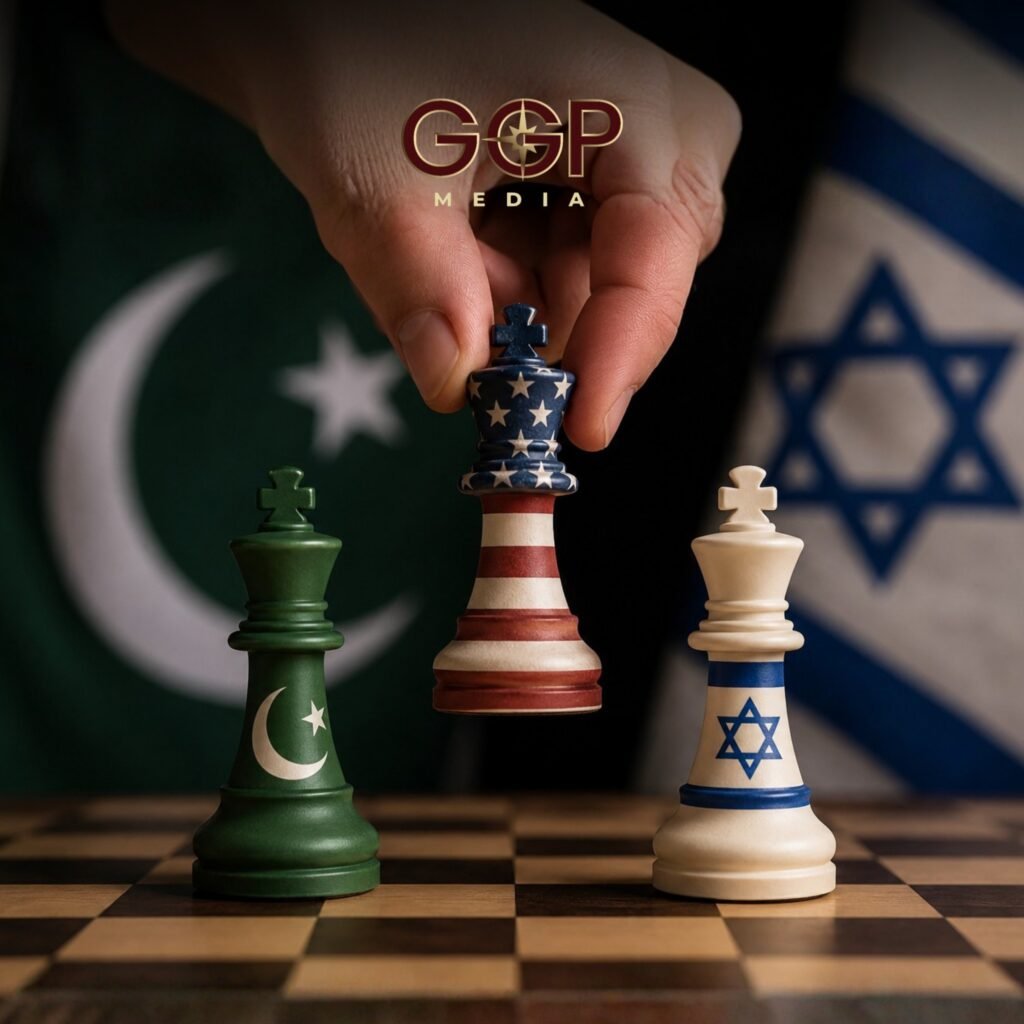
Understanding this issue requires examining the geostrategic position of Pakistan, its decades-old foreign policy posture, the influence of domestic public opinion, and the weight of Washington’s expectations all of which are colliding in real time.
Pakistan’s Historical Stance: A Non-Recognition Built on Principle
Since its founding in 1947, Pakistan has never recognized the State of Israel. This is not merely a diplomatic formality; it is a foundational pillar of Pakistani foreign policy. Pakistani passports have historically carried the notation that they are valid for all countries except Israel. Official state policy has long aligned with the Palestinian cause, viewing it as both a moral and Islamic obligation.
The geopolitical importance of Pakistan in the Muslim world has, in part, been built on this very stance. Islamabad has consistently positioned itself as a champion of Palestinian rights in multilateral forums at the United Nations, the Organisation of Islamic Cooperation (OIC), and beyond. For Pakistani leaders, abandoning this position would amount to a strategic and ideological surrender.
“For Pakistan, the Palestinian cause is not just a foreign policy position, it is a domestic political identity.”
The Abraham Accords and the Changing Regional Map
The latest geopolitics news from the Middle East cannot be divorced from the Abraham Accords of 2020, which saw the UAE, Bahrain, Sudan, and Morocco normalize ties with Israel under U.S. brokerage. Saudi Arabia, long considered the guardian of Sunni Islamic interests, has been engaged in quiet normalization discussions, reportedly accelerated by U.S. security guarantees and a proposed civil nuclear deal.
These recent geopolitical developments have fundamentally altered the calculus. If Saudi Arabia, home to Mecca and Medina were to formally recognize Israel, the political and religious cover that Pakistan has historically leaned on would erode significantly. The argument that “no major Muslim country recognizes Israel” would no longer hold.
This is precisely where U.S. pressure enters the picture. Washington, eager to cement its regional architecture before the next electoral cycle, has reportedly been quietly sounding out Islamabad on its willingness to move closer toward normalization or at least a softening of rhetoric.
The Geopolitical Importance of Pakistan: Why Washington Cares
Pakistan’s strategic importance to the United States is multidimensional. Sitting at the crossroads of South Asia, Central Asia, and the Middle East, Pakistan borders Afghanistan, Iran, India, and China making its geostrategic position uniquely sensitive. It is a nuclear-armed state with a battle-hardened military, a critical artery for regional supply chains, and a nation whose cooperation (or lack thereof) shapes U.S. objectives from counterterrorism to the containment of Chinese influence.
In terms of geopolitics today, Washington views any expansion of the Abraham Accords framework as a foreign policy win. Including Pakistan the world’s second-largest Muslim-majority country would be a significant diplomatic trophy. It would signal to the world that the normalization movement has gone mainstream, extending well beyond the Arab world.
But Pakistan is not a passive actor in this equation. Islamabad understands its own leverage. The Pakistan strategic importance in U.S. policy gives it bargaining chips: debt relief, IMF support facilitation, military equipment, and the long-sought Major Non-NATO Ally upgrade are all tools that Washington can use and Islamabad can demand.
The Domestic Red Lines: Why It Remains Politically Toxic
No analysis of international relations current issues involving Pakistan is complete without accounting for domestic politics. Pakistan’s civilian governments are structurally weak. The military establishment, religious parties, and an increasingly polarized public set hard limits on what any elected government can do in foreign affairs.
Surveys consistently show that the overwhelming majority of Pakistanis oppose recognition of Israel particularly in the context of the ongoing Gaza conflict. The images and narratives coming out of Gaza have galvanized public opinion in Pakistan more than in almost any other non-Arab Muslim country. Any leader who publicly moves toward normalization risks triggering mass protests, fatwa-level opposition from clerics, and a severe electoral backlash.
The geopolitics issues here are compounded by the fact that Pakistan’s military the ultimate arbiter of foreign policy has its own institutional reservations. Recognition of Israel could fracture internal religious cohesion in the armed forces, upset ties with Iran (a neighbor with which Pakistan maintains a delicate balance), and complicate relations with Turkey and Malaysia, fellow Muslim-majority countries that maintain anti-normalization positions.
“Recognition of Israel is not just a foreign policy decision for Pakistan, it is an existential political risk for any government that attempts it.”
The Economic Pressure Point: IMF, Debt, and U.S. Leverage
Pakistan’s foreign affairs current issues are deeply entangled with its economic fragility. With a history of IMF bailouts, a fragile current account balance, and a debt burden that limits policy space, Islamabad is structurally dependent on Western goodwill. The United States holds significant sway at the IMF and the World Bank, and this financial leverage is not lost on Pakistani policymakers.
Some analysts, featured prominently on platforms covering geopolitics news now and geopolitics news live, argue that economic desperation could eventually override political caution. History has shown that financially weakened states sometimes make geopolitical concessions that they would never make from a position of strength. The question is whether that breaking point is near.
However, there is a counterargument: China. As Pakistan deepens its engagement with Beijing through CPEC (China-Pakistan Economic Corridor) and broader diplomatic alignment, the relative weight of U.S. economic leverage diminishes. Islamabad increasingly has an alternative patron, one that has no interest in seeing Pakistan recognize Israel.
The China Factor in Pakistan’s Strategic Calculus
Any discussion of the geostrategic position of Pakistan must reckon with China’s growing role. Beijing is Pakistan’s all-weather friend, its largest bilateral lender, and its primary defense technology partner. China has consistently supported Pakistan’s position on Kashmir and, more broadly, maintains a policy of non-interference that contrasts sharply with U.S. conditionality.
China has no interest in seeing Pakistan align more closely with U.S.-brokered Middle East architecture. For Beijing, a Pakistan that normalizes relations with Israel represents a Pakistan that has tilted decisively back toward the Washington consensus a scenario that undermines China’s own regional influence and its goal of positioning itself as an alternative to the U.S.-led order.
This dynamic is reshaping the geopolitical conflicts that Pakistan must navigate. The country is increasingly caught between a Washington that wants normalization and a Beijing that quietly but firmly opposes it.
What the Geopolitics Experts Are Saying
On Pakistan foreign policy podcast circuits and in geopolitical podcast Pakistan discussions, analysts largely agree on one thing: formal recognition in the near term is unlikely. The political cost is too high, the public opposition too fierce, and the institutional resistance too deep.
However, what is more plausible and what some best Pakistani podcasts focused on strategic affairs have discussed is a quiet, incremental process. Back-channel communications, unofficial trade flows, and the kind of subtle diplomatic signaling that falls short of formal recognition but moves the needle nonetheless.
This approach would mirror how some other Muslim-majority countries operated for years before formal normalization maintaining official opposition while allowing pragmatic engagements below the surface.
The Gaza Variable: A Complication Washington Cannot Ignore
Perhaps the single biggest factor freezing any Pakistan-Israel rapprochement is the ongoing crisis in Gaza. The conflict has supercharged anti-Israel sentiment not just in Pakistan but across the Muslim world. No Pakistani leader, civilian or military can be seen moving toward Israel while images of the humanitarian crisis dominate television screens and mosque sermons.
This is a critical geopolitics issues dimension that is often underestimated in Western foreign policy circles. The U.S. may be able to offer economic incentives or security guarantees. But it cannot, in the short term, neutralize the political cost that any Pakistani government would pay for normalization while the Gaza crisis remains unresolved.
Bottom Line: Under the current geopolitical situation of Pakistan, domestic fragility, public opposition, the Gaza crisis, and China’s counter-pressure, formal recognition of Israel remains a bridge too far. U.S. pressure can shift incentives at the margins, but it cannot override the structural realities of Pakistani politics. The most likely outcome is not recognition but managed ambiguity: Islamabad maintaining its public position while quietly avoiding escalation and leaving future doors theoretically open.
Frequently Asked Questions
1. What is the current geopolitical situation of Pakistan regarding Israel recognition?
Pakistan has not recognized Israel since its founding in 1947. As of the latest geopolitics news, Pakistan maintains its non-recognition stance, citing the Palestinian cause and strong domestic public opposition. U.S. pressure and recent geopolitical developments including the Abraham Accords have intensified speculation, but no formal shift in Pakistan’s foreign policy has occurred. The geostrategic position of Pakistan, caught between U.S. expectations and Chinese influence, makes any near-term change highly unlikely.
2. How does Pakistan’s strategic importance influence U.S. efforts to push for Israel recognition?
Pakistan strategic importance to the United States stems from its location at the crossroads of South Asia and the Middle East, its nuclear capabilities, and its military partnerships. Washington has used financial leverage including support at the IMF as a tool in international relations current issues involving Pakistan. However, Pakistan’s deepening ties with China reduce Washington’s leverage, and the domestic political cost of recognizing Israel remains prohibitively high for any Pakistani government. The geopolitical importance of Pakistan cuts both ways: it gives the U.S. reason to push, and it gives Pakistan the leverage to resist.
3. Where can I follow the latest geopolitics news analysis on Pakistan’s foreign policy?
For latest geopolitics news analysis on Pakistan’s foreign policy and geopolitics issues, several platforms provide in-depth coverage. Podcast channel options include Pakistan foreign policy podcast discussions on platforms like Spotify and YouTube, as well as geopolitical podcast Pakistan-focused shows that cover foreign affairs current issues. Best Pakistani podcasts on strategy and international affairs often feature retired diplomats and security analysts. For geopolitics news live and geopolitics news now, outlets like Dawn, The News International, and global think-tank publications remain reliable sources for recent geopolitical developments and analysis.