
The Middle East is on fire. As the Iran war with Israel and us enters its second month, one country has quietly stepped into the centre of global diplomacy – Pakistan. In a conflict that has shaken oil markets, threatened the Strait of Hormuz, and drawn comparisons to the Cold War era, Islamabad has emerged as a critical back-channel between Washington and Tehran. This is not just a foreign policy win – it is a defining moment in Pakistan’s geopolitical identity.
Background: How the War Started
The Iran-US conflict 2026 did not emerge from a vacuum. Decades of sanctions, nuclear disputes, and proxy battles across the Middle East finally boiled over in early 2026. Combined US and Israeli strikes on Iranian nuclear and military facilities triggered a full-scale Iranian military response, including the closure of the Strait of Hormuz – through which nearly 20 percent of the world’s oil supply flows. The result has been a global energy crisis not seen since 1973.
Iran retaliated with drone and missile strikes on US military assets and Gulf state infrastructure. Within weeks, the world was watching a conflict that analysts feared could spiral into a wider regional war. The question on every strategist’s mind was: who could bridge this gap?
Pakistan Steps In: The Mediator No One Expected
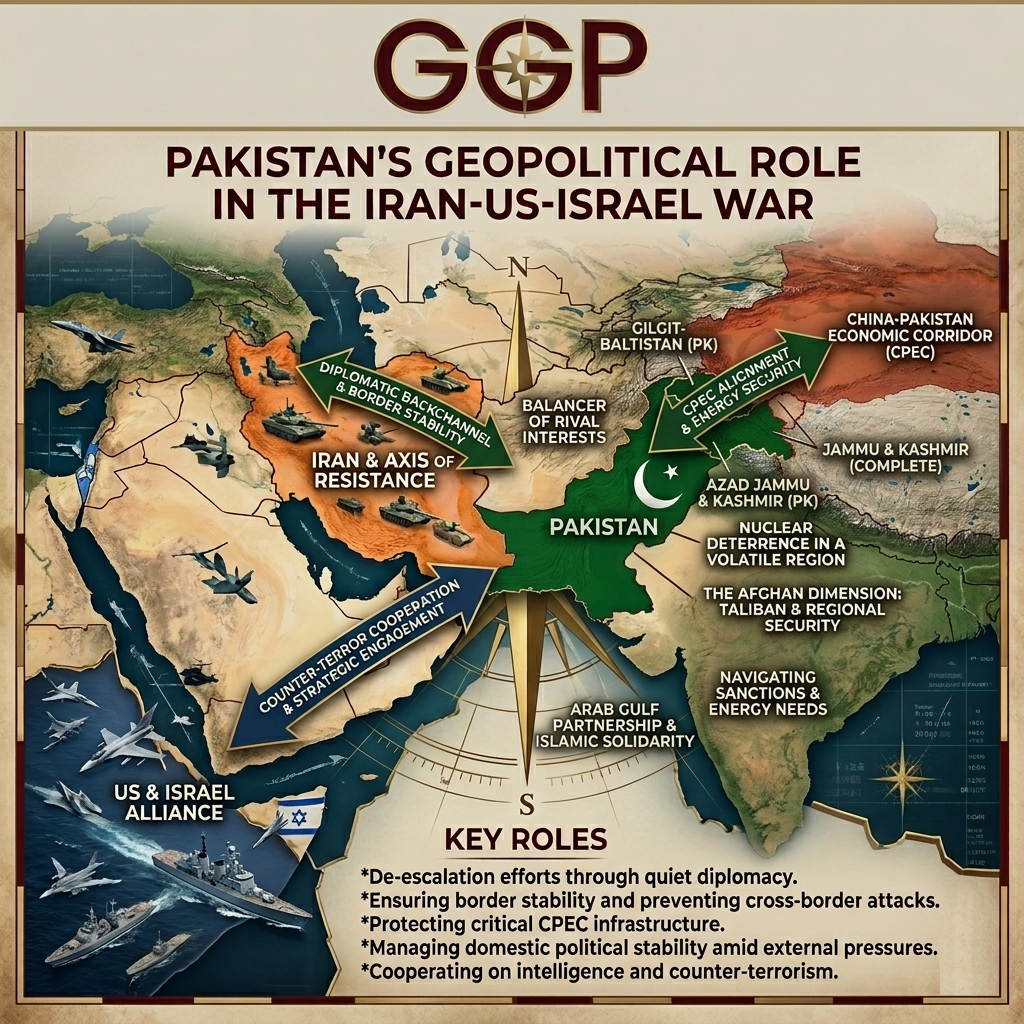
Pakistan’s emergence as a peace broker surprised many Western observers. Yet for those following Pakistan geopolitics analysis closely, it made complete sense. Islamabad holds a rare combination of assets: a warm working relationship with the Trump administration, deep cultural and religious ties with Iran, and credibility among Muslim-majority nations.
Pakistan’s Foreign Minister Ishaq Dar hosted the foreign ministers of Saudi Arabia, Turkey, and Egypt in Islamabad on March 29–30, 2026. Together, they produced a joint five-point initiative calling for an immediate ceasefire, urgent diplomatic engagement, and the restoration of maritime traffic through the Strait of Hormuz. Pakistan officially offered to host direct US-Iran negotiations – the first time such an offer had international backing from four major regional powers.
Even more remarkably, US Vice President JD Vance was, on two separate occasions, reportedly ready to fly to Islamabad for direct talks with Iranian representatives. Both attempts fell through at the last moment due to internal hesitations in Tehran. Yet the fact that Washington was willing to send its second-highest official to Pakistan for negotiations speaks volumes about Islamabad’s standing in this conflict.
Pakistan’s Unique Position: The Balancing Act
What makes Pakistan’s role so complex is the Great Game Pakistan has always played – navigating between superpowers without fully aligning with any. Pakistan shares a 900-kilometre border with Iran and hosts the world’s second-largest Shia Muslim population after Iran itself. At the same time, it has a defence pact with Saudi Arabia and has built strong personal ties with Donald Trump, whose administration described Army Chief Asim Munir as a close partner.
This dual positioning has forced Pakistan to walk a diplomatic tightrope. While condemning Israeli and US strikes on Iran, Islamabad carefully avoided naming Washington directly in early statements – a calculated move to preserve its role as a credible go-between. Pakistan also declined to join a UK-hosted maritime task force for the Strait of Hormuz, fearing it would be seen as taking sides.
One senior Pakistani analyst summed it up bluntly: we can take the horse to the water, but whether the horse drinks is not up to us.
US vs Iran: The Military Reality
The question of US vs Iran war who would win is one that dominates online searches and strategic debates alike. Militarily, the United States holds an overwhelming advantage in air power, naval capability, and precision strike technology. However, Iran possesses significant asymmetric tools: a vast ballistic missile arsenal, trained proxy forces across Iraq, Syria, Lebanon, and Yemen, and the geographic chokehold of the Strait of Hormuz.
A prolonged conflict would impose enormous costs on both sides. Iran cannot win a conventional war against the US-Israeli alliance, but it can make such a war extraordinarily costly and destabilising for global energy markets. That calculation is precisely why diplomacy remains the only realistic exit ramp – and why Pakistan’s role as mediator is not just helpful, but necessary.
What Pakistan Gains – and What It Risks
For Pakistan, successful mediation would be a historic diplomatic achievement – one comparable to its role in facilitating Henry Kissinger’s secret 1971 visit to China. If peace talks result from Pakistan’s efforts, Islamabad’s international standing would be elevated dramatically, opening doors for economic investment, debt relief, and stronger US ties.
However, the risks are equally real. Pakistan has defence obligations to Saudi Arabia, which has been attacked by Iranian forces. If those attacks escalate, Islamabad may face unbearable pressure to choose a side. Its domestic politics – with a large, deeply religious population that views the war through a sectarian lens – add another layer of complexity. Analysts following the Pakistan foreign policy podcast circuit have noted that public opinion within Pakistan strongly opposes any military entanglement.
The worst-case scenario for Pakistan is being pulled into the conflict directly. Islamabad has so far avoided this outcome through careful language and firm neutrality – but that position grows harder to maintain with every passing week of escalation.
The Road Ahead: Can Pakistan Deliver Peace?
As of early April 2026, the situation remains volatile. Iran has publicly praised Pakistan’s mediation while privately maintaining deep suspicion of Washington’s intentions. The US has signalled openness to talks but has continued military operations simultaneously. Iran’s parliament speaker has dismissed negotiations as cover for a planned ground invasion.
What is clear is that no other country currently has the relationships with both sides that Pakistan does. China has backed Pakistan’s mediation efforts. Saudi Arabia, Turkey, and Egypt have endorsed Islamabad as the preferred venue. The structure for peace exists. What is missing is political will – particularly from Tehran, which remains unwilling to negotiate under what it calls the conditions of the aggressor.
Pakistan’s window of relevance is narrow. Diplomacy moves fast in wartime. If the conflict de-escalates without Pakistan’s direct involvement, Islamabad loses its moment. If it escalates into a ground war, Pakistan may be forced off the fence entirely.
Conclusion
The Iran-US-Israel war has given Pakistan a rare geopolitical opportunity – one that comes once in a generation. Through careful diplomacy, personal relationships with both Washington and Tehran, and the backing of key regional powers, Islamabad has positioned itself as the world’s most important back-channel in one of history’s most dangerous conflicts.
Whether Pakistan can convert this position into lasting peace remains uncertain. But one thing is beyond debate: in the middle of the most consequential war of 2026, all diplomatic roads lead through Islamabad.
Frequently Asked Questions (FAQ)
Q1: What is Pakistan’s role in the Iran US conflict 2026?
Pakistan has emerged as the primary diplomatic back-channel between the United States and Iran during the 2026 war. Islamabad has relayed peace proposals, hosted foreign ministers from Saudi Arabia, Turkey, and Egypt, and officially offered to host direct US-Iran negotiations. The effort is rooted in Pakistan’s unique position as a country with strong ties to both Washington and Tehran – a balance no other nation currently holds.
Q2: Who would win in a US vs Iran war?
The United States holds a decisive military advantage in conventional warfare, with superior air power, naval forces, and precision-strike capabilities. However, Iran’s asymmetric strengths – including its ballistic missile program, regional proxy forces, and control of the Strait of Hormuz – mean Iran is defending perfectly, which shows that any conflict would be prolonged, costly, and deeply destabilizing for global energy markets. Most analysts agree there is no clean military victory for either side, which is why diplomacy remains the most viable path forward.
Q3: Why is Pakistan geopolitics important in the Iran-Israel-US war?
Pakistan’s geopolitical importance in this conflict stems from its rare dual relationships: strong ties with the Trump administration and cultural-religious ties with Iran, including being home to the world’s second-largest Shia Muslim population. These relationships give Pakistan credibility with both warring parties – something that even China, Russia, or Europe cannot claim in equal measure. Understanding Pakistan geopolitics analysis is essential to understanding how this conflict might end.