
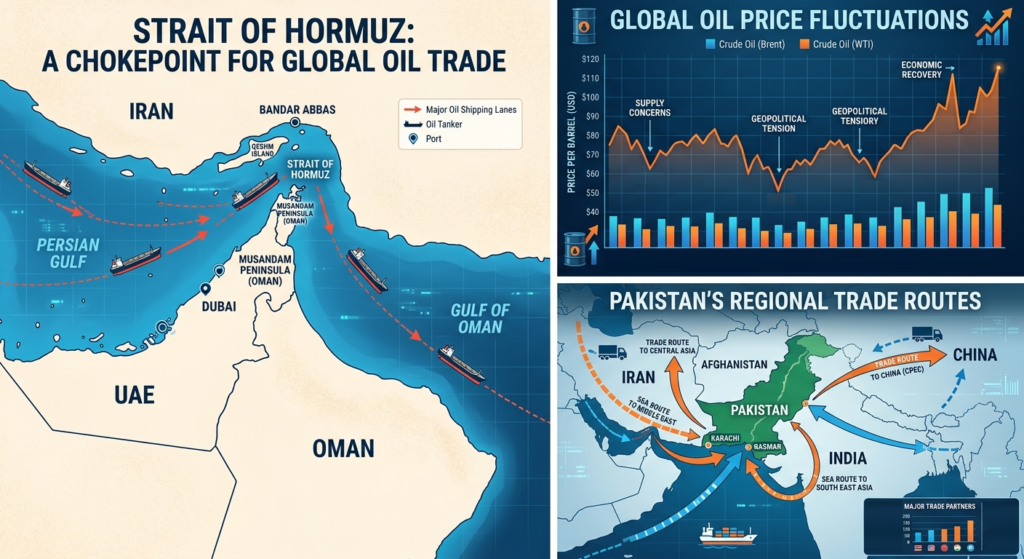
The Strait of Hormuz — a narrow waterway barely 33 kilometres wide at its tightest point — carries roughly 20 percent of the world’s oil supply every single day. When tensions between Washington and Tehran escalate, this strait does not simply become a military flashpoint; it becomes a pressure valve for the entire global economy. For Pakistan, a country that shares a border with Iran, depends heavily on energy imports, and has historically walked a careful diplomatic tightrope, the stakes of the current Hormuz Crisis Management debate could not be higher.
The Hormuz Flashpoint: What Is Actually Happening?
The roots of the current crisis stretch back through decades of sanctions, nuclear negotiations, and proxy conflicts. However, 2025 and early 2026 brought a new intensity to US-Iran Conflict Mediation efforts, with back-channel talks repeatedly breaking down while military buildups on both sides accelerated.
Iran has repeatedly threatened to close the Strait of Hormuz in response to American economic pressure and military positioning in the Persian Gulf. The United States has responded by reinforcing its naval presence, while regional actors — including Saudi Arabia, the UAE, and Oman — have scrambled to find diplomatic off-ramps before the situation tips into open conflict.
The latest geopolitics news coming out of the region suggests that while a full naval blockade remains unlikely, targeted harassment of tanker traffic, drone attacks on oil infrastructure, and calculated shows of force are already raising insurance premiums and pushing spot oil prices upward. For countries like Pakistan that import the majority of their energy needs, even a modest spike in crude prices translates directly into inflation, trade deficits, and fiscal stress.
Pakistan’s Strategic Position in the Middle of It All
Pakistan occupies a uniquely sensitive position in this crisis. Geographically, it borders Iran to the west. Economically, it relies on Gulf states for remittances that are a lifeline for millions of Pakistani families. Diplomatically, it has security partnerships with the United States while maintaining civilised, if cautious, relations with Tehran.
Pakistan Strategic Insights analysts have long argued that Islamabad’s greatest asset in any regional confrontation is precisely this multi-directional positioning — but that asset comes with an equally great responsibility to stay neutral without appearing indifferent.
Three key strategic concerns dominate Pakistan’s calculations:
• Energy Security: Pakistan’s LNG import agreements and future gas pipeline dreams run directly through or adjacent to the Strait of Hormuz corridor. Any prolonged disruption would worsen an already strained energy mix.
• Remittance Flows: Over four million Pakistanis work in Gulf States. Conflict-driven economic slowdowns in the region could reduce the remittances that currently prop up Pakistan’s foreign exchange reserves.
• Diplomatic Capital: Pakistan has offered itself as a back-channel mediator in past Iran-US standoffs. Playing this role effectively requires maintaining credibility with both sides — a delicate balancing act under intense pressure.
These pressures are regularly dissected on the best Pakistani podcasts focused on strategic affairs, where retired military officers, former diplomats, and independent analysts debate Islamabad’s options with a frankness rarely found in mainstream media.
Domestic Economic Impact: Pakistan Pays the Price
No geopolitical crisis stays neatly confined to the global stage. The Domestic Economic Impact of Hormuz instability on Pakistan is already visible in multiple economic indicators — and analysts warn that the worst-case scenarios have not yet fully materialized.
Oil Prices and Inflation
Pakistan imports nearly 80 percent of its crude oil needs. When Brent crude moves upward on war premium fears, Pakistan’s import bill swells almost immediately. This feeds directly into petrol prices, transport costs, and ultimately the price of food and basic goods that ordinary Pakistanis pay every day.
Currency and Reserves
A higher oil import bill puts pressure on Pakistan’s foreign exchange reserves and weakens the Pakistani rupee. A weaker rupee then makes all other dollar-denominated imports more expensive — creating a compounding cycle of inflation that the State Bank of Pakistan must manage with limited tools.
Trade Routes and CPEC
The China-Pakistan Economic Corridor was partly envisioned as a trade route that would reduce Pakistan’s dependence on sea lanes vulnerable to great power competition. However, the full operationalization of Gwadar as a commercial port still has a long road ahead. Until then, Pakistan’s trade remains deeply exposed to any disruption along Gulf shipping lanes — making Hormuz Crisis Management not just a foreign policy issue but a core economic priority for Islamabad.
US-Iran Conflict Mediation: Where Does Pakistan Fit?
Pakistan’s experience with US-Iran Conflict Mediation is not theoretical. In previous decades, Pakistani intermediaries quietly facilitated communication between Washington and Tehran when official channels were frozen.
However, the current political climate inside Pakistan — marked by domestic political turmoil, an IMF programme with strict conditionality’s, and a civil-military relationship navigating its own complexities — limits how boldly Islamabad can project itself as a regional peacemaker. The government must balance the optics of engagement against the risk of being seen as taking sides in a conflict where either outcome carries costs for Pakistan.
The latest geopolitics news from diplomatic circles suggests that Oman remains the preferred channel for any back-channel US-Iran communication, with Pakistan positioned as a supportive but secondary player. Whether Islamabad can leverage this moment to build longer-term diplomatic capital remains one of the central questions of Pakistan Strategic Insights commentary heading into mid-2026.
The Road Ahead
The Hormuz crisis is not a story that will resolve itself quietly. Whether through a breakthrough in US-Iran Conflict Mediation or a further escalation that rattles global energy markets, Pakistan will feel the effects across its economy, its diplomacy, and its strategic choices. Understanding those effects — their causes, their scale, and Pakistan’s available responses — is exactly what platforms like Great Game Pakistan exist to provide.
The Domestic Economic Impact is real. The diplomatic balancing act is genuinely difficult. And the quality of public debate around these challenges depends on the strength of the media ecosystem that covers them. That is why the continued growth of serious, independent, and best Pakistani podcasts and leading Pakistani podcast channels is not just a media story — it is a civic necessity.
Stay informed. Stay engaged. The game is still being played.
Frequently Asked Questions
Q1: What is the Hormuz Crisis and why does it matter for Pakistan?
The Hormuz Crisis Management challenge arises from escalating tensions between the US and Iran near the Strait of Hormuz, a critical chokepoint for global oil trade. For Pakistan, it matters because disruptions to this waterway directly raise oil import costs, weaken the rupee, and create fiscal pressure — intensifying the Domestic Economic Impact that ordinary citizens feel through inflation and rising fuel prices. Pakistan also has strategic diplomatic interests in de-escalation, given its geographic and economic ties to both the Gulf region and Iran.
Q2: Is Pakistan involved in US-Iran Conflict Mediation efforts?
Pakistan has historically played an informal role in US-Iran Conflict Mediation, leveraging its position as a country with ties to both Washington and Tehran. However, domestic pressures and the current geopolitical environment have limited how prominently Islamabad can lead such efforts. The latest geopolitics news indicates Oman is the primary back-channel, with Pakistan maintaining a supportive role while protecting its own strategic interests — a classic example of Pakistan Strategic Insights in action.
Q3: Where can I find expert analysis on these issues from a Pakistani perspective?
The best place to start is with the best Pakistani podcasts focused on defense and foreign policy. Great Game Pakistan is among the leading Pakistani podcast channels that regularly features retired military analysts, former diplomats, and independent researchers breaking down the latest geopolitics news. Visit ggpak.com for curated video content, in-depth blog posts, and live podcast sessions covering Pakistan Strategic Insights and global affairs.